


Introduction
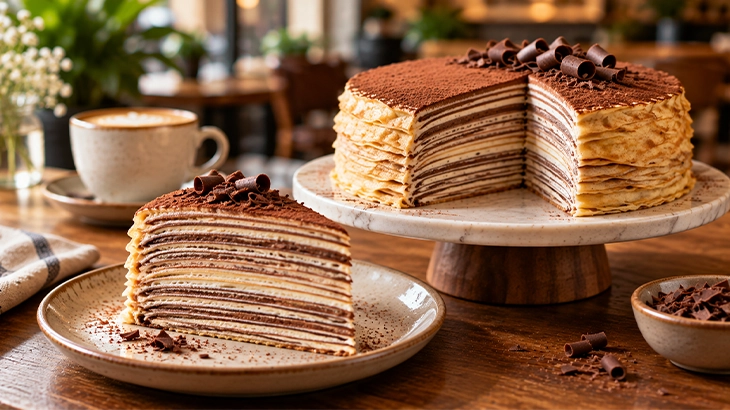
Layered crepe cakes have become one of the most photographed desserts on café counters, and it’s easy to see why. A cross-section showing twenty delicate layers looks far more expensive than the humble crepe it’s made from. That visual impact lets cafes charge a premium price for a dessert whose base is simple, inexpensive batter.
However, the challenge lies in turning out dozens of identical, tear-free crepes without eating into service hours. Crepe Mix from Nitin’s Premixes gives cafes a consistent batter to build this showpiece on. This allows one product to be presented on an everyday crepe menu and also to sell as a premium cake.
What Makes a Mille Crepe Cake Work for a Café?
A mille crepe cake looks complicated, but a few practical details decide whether it becomes a profitable counter item or a one-time experiment.
-
A Modest Base With a Premium Price Tag
Mille is a Latin word, which means a thousand. A real mille crepe cake usually stacks around fifteen to twenty layers, sometimes more. The ingredients are inexpensive. So, what patrons pay for is the visible craftsmanship in every slice.
That makes it a natural price anchor. Cafes can place a mille crepe slice beside a cheesecake or brownie slice. It will then sit at the top of the dessert range without needing exotic ingredients for justifying its premium tag.
-
Good for Telling an Interesting Menu Story
Layered crepe cakes have existed in French pastry for nearly 300 years. The tall, multi-layered version seen in cafes today is credited largely to Japanese pastry chef, Kazuko Emy Wada. She began selling flavoured crepe cakes at a Tokyo pastry shop in 1985.
The format later reached New York through the Lady M brand in 2001. This is a useful detail for menu storytelling. Just a single line about the dessert’s Tokyo-to-New-York journey will give patrons a reason to order it.
-
Crepes Layers Can Be Stored for Days
Unlike many desserts, the crepe layers don’t need to be cooked at the time of service. Once cooled, they can be stacked and refrigerated for several days. Cafes can cook the layers during quiet mid-afternoon hours and assemble later.
This moves the labour out of peak service hours. It matters a lot in café kitchens where the same team is also handling orders. However, cafes should still check storage times against their own food-safety protocols.
-
A Premix Can Be Used for Greater Efficiency
In a single crepe, a slightly thicker or thinner pour goes unnoticed. In a stack of twenty, those small differences add up. The cake can end up leaning to one side or bulging in the middle. Batter drift makes this worse.
Batter left sitting tends to thicken as a batch goes on, which is why bakers are advised to stir before every pour. Crepe Mix from Nitin’s Premixes removes much of this variability, since the batter starts from a fixed formulation. The staff only need to follow the same measured ratio each time.
-
Even The Imperfect Crepes Can Be Put to Use
Not every crepe in a batch will be perfect, and a cake doesn’t need them to be. The best-looking crepe goes on top. The ones with small tears can sit in the middle layers where the filling hides them.
Crepes with holes are best kept away from the top, the bottom, and any layer that uses a thin spread like jam. This is because the filling can show through. Trimmed edges don’t need to be binned either. They can be crisped into a crunchy topping for the finished slice.
-
Two Delicious Flavours Can Be Used for a Striped Slice
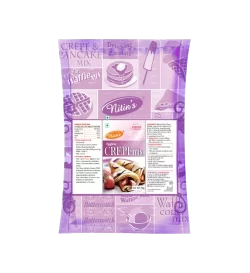
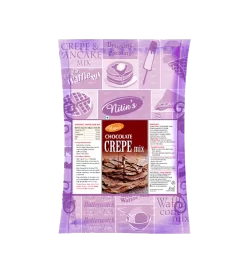
Because Crepe Mix from Nitin’s Premixes is available in vanilla and chocolate, cafes can alternate the two flavours as they stack. The result is a slice reveal with clear light-and-dark stripes. It looks attractive in photos without any extra recipe or decoration.
This is a small trick, which can have a massive impact on social media. A striped cross-section tends to make patrons pull out their phone. This free exposure is worth more than most promotional posts.
Chill Firmly, Slice Cold, Serve Slightly Softened
A freshly assembled cake needs at least a couple of hours in the fridge for the filling to set. Slicing it while cold gives cleaner edges. Letting each slice rest for a few minutes before serving softens the texture, so the layers feel tender rather than stiff.
Training staff on this simple sequence prevents the most common display problem – a slice that looks perfect in the case but collapses on the plate.
Sell Whole Cakes, Not Just Slices
A mille crepe cake also works as a pre-order item for birthdays and small celebrations. Smaller whole cakes give cafes a way to reach patrons who aren’t walking in for dessert that day.
Such cakes also offer a higher revenue potential than a single slice. Cafes can start with one or two flavours as weekend specials. It would be a low-risk way to test demand before committing counter space to the cake every day.

Conclusion
A mille crepe cake is as much a test of kitchen discipline as it is a dessert. The cafes that do it well treat batter as a measured, repeatable process rather than something adjusted by feel. This is because twenty layers expose every inconsistency.
A sensible way to begin is by baking a single cake as a weekend special. The cafes can then track how many slices sell, and expand only if demand holds. Crepe Mix from Nitin’s Premixes helps cafes build this premium showpiece with the batter consistency it demands, without adding extra complexity to the kitchen.
How Frozen Yogurt Desserts Increase Profitability of Cafes
Discover how cafés can boost their profit margins with irresistible desserts prepared using frozen yogurt dessert premixes from Nitin’s Premixes.
Comments are closed.