


Introduction
Ever heard of stroopwafels? If you’re someone who frequents cafes, you might’ve come across these sweet wafer cookies. They might’ve also sparked some curiosity in you to know where they came from.
A sweet snack with an interesting origin tends to stick in a patron’s memory far longer than one that’s simply described by its ingredients. The stroopwafel is a particularly good example of this, since it carries a two-century-old story.
Most Indian cafes serving it might’ve never included stroopwafels in their menu. The Stroopwafel Mix from Nitin's Premixes gives cafes a way to bring this dessert onto their menu, and its backstory is worth telling alongside it.
The Intriguing Origins of a Dutch Classic
Long before stroopwafels became an Instagram-friendly café item, they started as a practical solution to a very ordinary bakery problem.
The stroopwafel’s history traces back to the Dutch city of Gouda, sometime in the late 1700s or early 1800s. The earliest written recipe for this syrup waffle dates back to around 1840. One commonly repeated account credits a baker named Gerard Kamphuisen for stroopwafels.
Kamphuisen was reportedly trying to find a use for the dough scraps and breadcrumbs piling up in his bakery rather than letting them go to waste. His first attempt at pressing these leftovers into a waffle iron didn’t go well. The result was dry and crumbled pieces.
The fix came from an unlikely source. It was the syrup, which bound the crumbs together and gave the waffle the chewy, held-together texture.
From a Baker’s Fix to City-Wide Trade
What began as a baker's workaround for wasted dough turned into a genuine local industry within a few decades. By the mid-19th century, Gouda was home to roughly a hundred bakers making their own version of this syrup waffle.
For a long time, the city held something close to a monopoly on the stroopwafel. It wasn’t until around 1870 that stroopwafels began appearing outside Gouda. They were sold from market stalls and street carts across the wider Netherlands.
The Ritual That Made It More Than a Snack
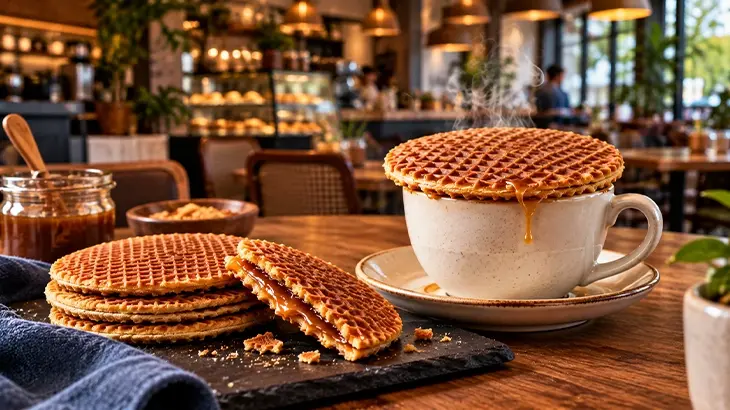
Part of what helped the stroopwafel stand apart from other baked treats is a serving ritual tied directly to its shape. Its circular size fits almost perfectly over the rim of a teacup or coffee cup. Resting it there lets the steam rising from the hot drink gently soften the syrup filling inside.
This wasn’t a marketing invention. It developed naturally out of the product’s size and the syrup’s texture. Interestingly, it’s how the stroopwafel is eaten in the Netherlands even to this day. Most cafes serving stroopwafels skip this ritual entirely, missing a genuinely simple way to turn the dish into a cherishable moment at the table.
Reintroducing this serving style costs a café nothing extra in ingredients. Yet, it can give the dish a point of difference that most plated desserts simply can’t offer. Before the first bite, the patron will actively be a part of an interactive moment.
From Dutch Markets to Global Pantries
Through the 20th century, stroopwafel production scaled well beyond individual bakeries into dedicated factories. Dozens of them were operating in Gouda alone by the 1960s. From there, the treat found its way into supermarkets, travel snack aisles, and eventually into an unexpected niche – endurance sports.
Cyclists and long-distance athletes adopted it as a compact, calorie-dense snack during long rides. This journey from a bakery’s leftover scraps to a shelf-stable travel and sports snack is part of what makes the stroopwafel’s story truly amazing.
How It Found Its Way to Indian Cafes
The stroopwafel’s arrival in Indian cafes fits into a broader pattern of global desserts. Cafes looking to diversify beyond traditional Indian sweets and standard bakery items make it a part of their menu. Social media played a significant role in this as well, since a dessert that looks distinctive photographs well and travels quickly across platforms.
What’s often missing in this adoption though is the context that makes the dessert more than just another import. A café that can share even a short version of the stroopwafel’s origin story, gives patrons a reason to engage with the dish beyond its appearance. This kind of storytelling costs nothing to add to a menu description.
Keeping the Authenticity While Scaling
Recreating the exact syrup-to-waffle balance that defines a proper stroopwafel isn't simple to do consistently by hand, especially across different kitchens and staff. The Stroopwafel Mix from Nitin's Premixes is formulated to help cafes replicate that same balance reliably. This gives kitchens a dependable base to build the dish on, without needing to test ratios from scratch.
This matters particularly for a dessert whose entire appeal rests on a specific texture that’s chewy, syrup-bound, and not too dry. Getting this wrong undermines the very thing that made the stroopwafel popular in the first place.

Conclusion
The stroopwafel’s journey gives it a richer story than most desserts that made their way into the global cafes. Sharing even a small piece of that history, or simply reviving the hot-cup serving ritual, can turn a familiar order into something patrons will remember and talk about.
Cafes that treat the stroopwafel as more than just another imported dessert stand to get more engagement out of it than those that don’t. The Stroopwafel Mix from Nitin’s Premixes gives cafes a dependable way to bring this two-century-old treat to their counter, ready for its next chapter.
How Frozen Yogurt Desserts Increase Profitability of Cafes
Discover how cafés can boost their profit margins with irresistible desserts prepared using frozen yogurt dessert premixes from Nitin’s Premixes.
Comments are closed.